- Form
- 7220, Rev. December 2025
- Attach to
- The credit form on line 6, with your return
- How many
- One per facility, again in later alteration or repair years
- Not needed
- Beginning of construction or 1 MW exception
- Penalties
- Computed in Parts III and IV, paid via Form 4255
At a glance
Form 7220, Prevailing Wage and Apprenticeship (PWA) Verification and Corrections, backs up a claim for the increased (five times) clean energy credit or deduction. The current revision is December 2025 (OMB No. 1545-0123), with instructions revised 12/2025. This page is general information, not tax advice.
- Who files. The taxpayer claiming the increased amount, with its return, alongside the credit form checked on line 6.
- One per facility. The instructions say to “file a separate Form 7220 for each facility”: three Forms 8835 mean three Forms 7220. IRS account staff work from the same rule: for the investment credits, IRM 21.7.4.4.8.3.1(15) says taxpayers claiming the increased amounts “must file Form 7220, Prevailing Wage and Apprenticeship (PWA) Verification and Corrections for each facility”.
- Later years too. “You must file a separate Form 7220 to report ongoing compliance with the prevailing wage requirements for alterations or repairs” on facilities placed in service in a prior year.
- Who does not file. With the beginning of construction exception (construction began before January 29, 2023) or the one megawatt exception, “you’re not required to file Form 7220”. See the bonus credit and its exceptions.
- Penalties. Part III computes the $50 per hour apprenticeship penalty, Part IV the $5,000 per worker prevailing wage penalty; both go to Form 4255.
Contractors and subcontractors do not file Form 7220, but their payroll fills most of it: Parts II to V have one row per employer and Davis-Bacon classification, with the employer's EIN. Under Treas. Reg. 1.45-7(b)(6)Treas. Reg. 1.45-7Treasury regulations, eCFR, “The taxpayer is solely responsible for ensuring that laborers and mechanics are paid wages not less than the prevailing rate”, whoever employs them, so expect the developer to ask every contractor for headcount, hours, wages and fringes by classification. The IRS posts the form on its About Form 7220 page with the instructions.
Tap a box once for its note, again to jump to the line. Zoom in to read the small print.
Part I, line by line
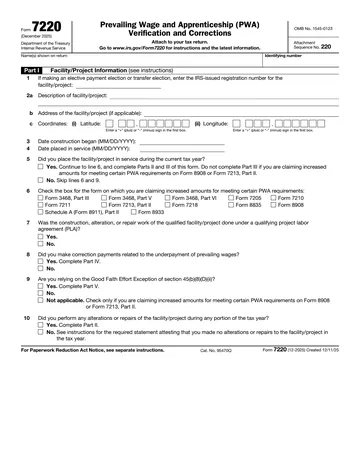
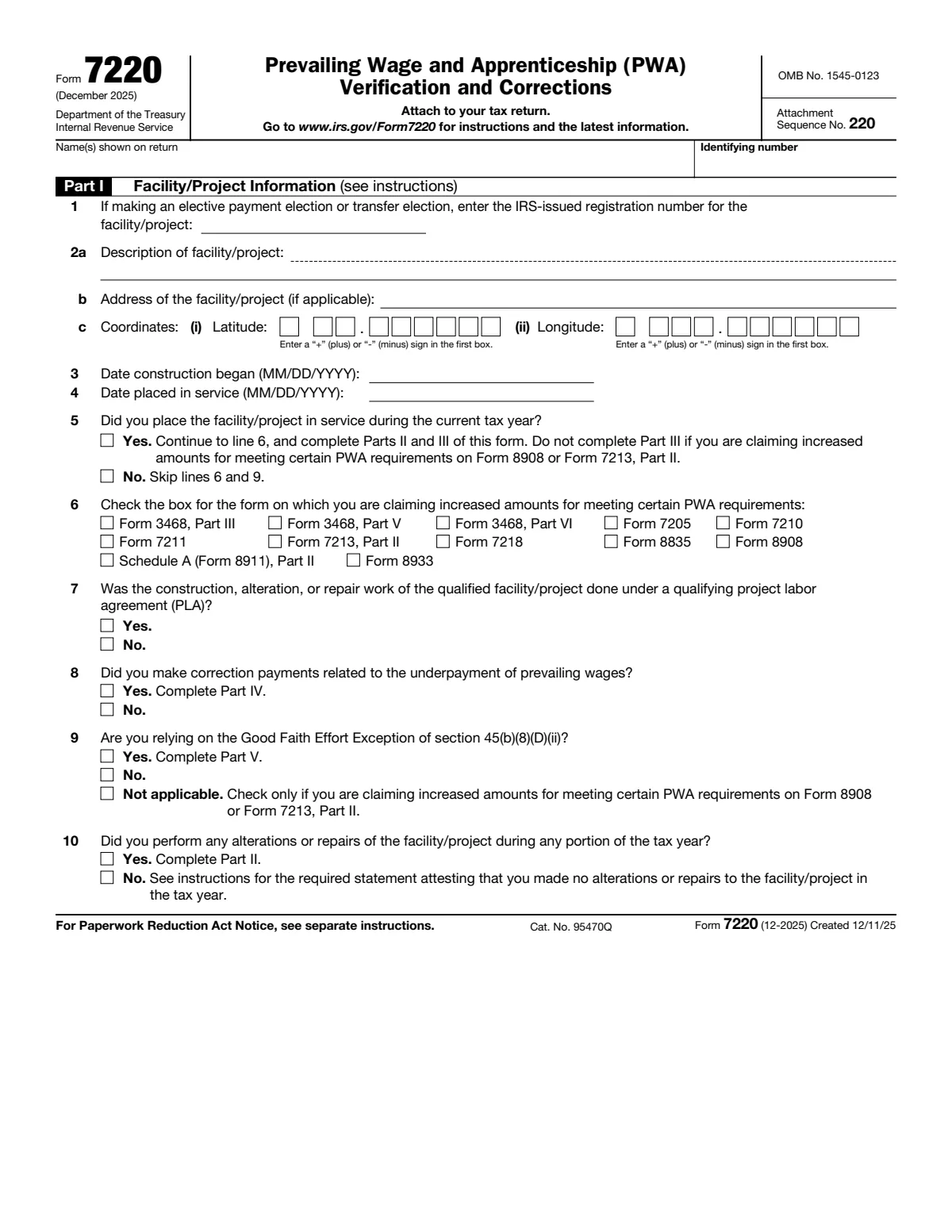
Part I describes the facility and answers the questions that decide which other Parts you complete. The notes follow the Form 7220 instructions, with the regulation where it settles the point.
| Line | Label | What goes there |
|---|---|---|
| Name | Name(s) shown on return | The filer's name as on the return the form is attached to. |
| ID | Identifying number | The identifying number on that return. |
| 1 | IRS-issued registration number | Only if you make an elective payment or transfer election: the pre-filing registration number the IRS issued for this facility. The IRS issues one for each applicable credit property through its pre-filing registration tool and says to register, in general, after the property is placed in service and at least 120 days before the return's due date (including extensions). Use the same number on the credit form and on Form 3800, Part III, and renew it each year: the Form 3800 instructions say “A registration number is valid only for the tax year for which it was obtained.” They also warn that “Completion of the pre-filing registration requirements and receipt of a registration number do not, by themselves, mean that you have earned the credit and made a proper election under section 48D(d), 6417, or 6418.” If the IRS cannot verify the number, it does not process the election (IRM 21.7.4.4.9.5(11)). Public owners: see elective pay and PWA. |
| 2a | Description of facility/project | A description of the facility or project. In the instructions, facility also covers a property, project, technology, equipment or residence. |
| 2b | Address of the facility/project (if applicable) | The facility's address, if it has one. |
| 2c | Coordinates | Latitude (i) and longitude (ii), with a plus or minus sign in the first box of each. |
| 3 | Date construction began (MM/DD/YYYY) | Set by either the Physical Work Test (physical work of a significant nature, with a continuous program of construction) or the Five Percent Safe Harbor (5% or more of total cost paid or incurred, with continuous effort to finish); one is enough. The date matters twice: construction begun before January 29, 2023 uses the exception in Treas. Reg. 1.45-6(b)(2)Treas. Reg. 1.45-6Treasury regulations, eCFR and needs no Form 7220, and the apprentice share of labor hours is 12.5% for construction begun in 2023 and 15% after December 31, 2023 (1.45-8(b)(2))Treas. Reg. 1.45-8Treasury regulations, eCFR. Wind and solar under 45Y and 48E have stricter rules in Notice 2025-42. |
| 4 | Date placed in service (MM/DD/YYYY) | The date the facility was originally placed in service. For 45L, the date the qualified residence was acquired by a person for use as a residence. |
| 5 | Placed in service during the current tax year? | Yes: continue to line 6 and complete Parts II and III, but not Part III for Form 8908 (45L) or Form 7213, Part II (45U), which have no apprenticeship requirement. No (a later year): skip lines 6 and 9. |
| 6 | Form on which you claim the increased amount | The credit form that carries the increased amount. The table under Rules that matter maps each box to its credit. |
| 7 | Qualifying project labor agreement (PLA)? | Yes if the work was done under a qualifying PLA: a pre-hire collective bargaining agreement meeting the six tests in Treas. Reg. 1.45-7(c)(6)Treas. Reg. 1.45-7Treasury regulations, eCFR(ii). Then the $5,000 and $50 penalties do not apply, provided any correction payment owed is paid by the date you claim the increased amount. |
| 8 | Correction payments for underpaid prevailing wages? | Yes if you made correction payments for prevailing wage underpayments and are reporting them, with any penalty payments. Then complete Part IV. |
| 9 | Relying on the Good Faith Effort Exception? | Yes if you rely on Treas. Reg. 1.45-8(f)(1)Treas. Reg. 1.45-8Treasury regulations, eCFR; complete Part V. Not applicable only for Form 8908 or Form 7213, Part II. See the good faith effort guide. |
| 10 | Alterations or repairs during the tax year? | Yes: complete Part II for that work, and Part IV if you made correction payments. Routine maintenance does not count. No: attach a statement with your name, TIN and facility description (and owner, if not the filer) saying no alterations or repairs were made, with a declaration signed by the taxpayer or a person authorized to bind it: “Under penalties of perjury, I declare that I have examined this statement, including accompanying documents, and to the best of my knowledge and belief, the facts presented in support of this statement are true, correct, and complete.” Skip Parts II and IV for 30C, 45L, 179D or 48C in a year the facility was not placed in service. |
Part II: prevailing wages paid
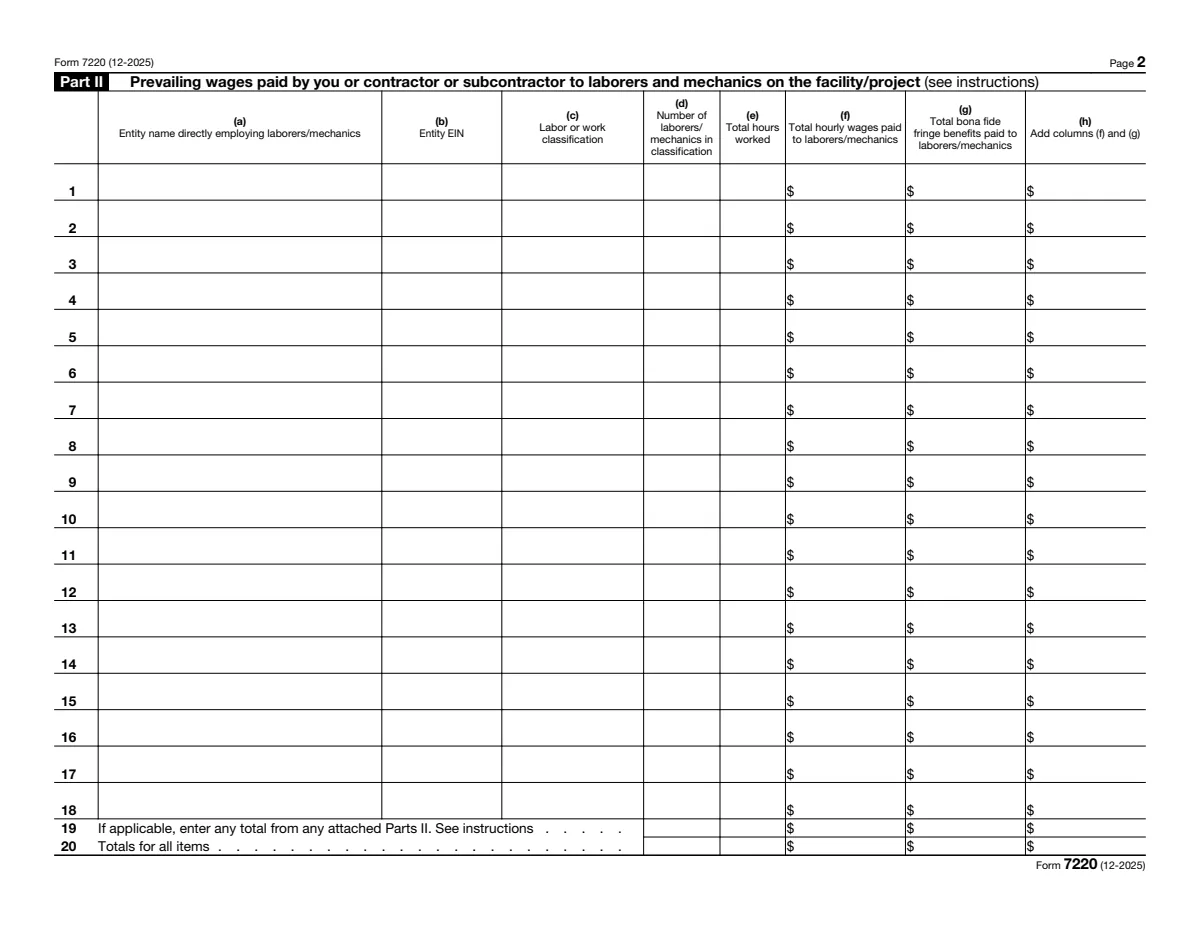
Complete Part II in the placed-in-service year (line 5 Yes) and in any later year with alteration or repair work (line 10 Yes). The rates come from the Davis-Bacon wage determination; see the IRS prevailing wage requirement.
| Line | Label | What goes there |
|---|---|---|
| II(a) | Entity name directly employing laborers/mechanics | The taxpayer, contractor or subcontractor that directly employs the workers. Each employer gets its own rows, one per classification. |
| II(b) | Entity EIN | The employer identification number of that entity. |
| II(c) | Labor or work classification | “Enter each labor or work classification as defined by the Davis-Bacon Act”, from the wage determination for the area where the work is done, used consistently for the whole job. |
| II(d) | Number of laborers/mechanics in classification | Workers in that classification for that entity. Duties decide who counts, whether the person is treated as an employee or an independent contractor for other federal tax purposes. |
| II(e) | Total hours worked | All hours worked in the classification for that entity, qualified apprentices included. |
| II(f) | Total hourly wages paid to laborers/mechanics | Hourly wages paid for those hours, apprentices included. The column has a dollar sign and (h) adds it to the fringe total, so it reads as dollars paid, not a rate. |
| II(g) | Total bona fide fringe benefits paid | Fringe benefits described in 29 CFR part 529 CFR part 5Code of Federal Regulations, eCFR (medical, retirement, insurance, vacation or holiday pay, apprenticeship costs), apprentices included. They “don’t include benefits required by other federal, state or local laws”. |
| II(h) | Add columns (f) and (g) | Column (f) plus column (g). |
| II-19 | Totals from any attached Parts II | Use as many copies of Part II as you need; carry the extra pages' totals of columns (d) to (h) here. |
| II-20 | Totals for all items | Rows 1 to 18 plus line 19, column by column. |
Part III: apprenticeship and penalties
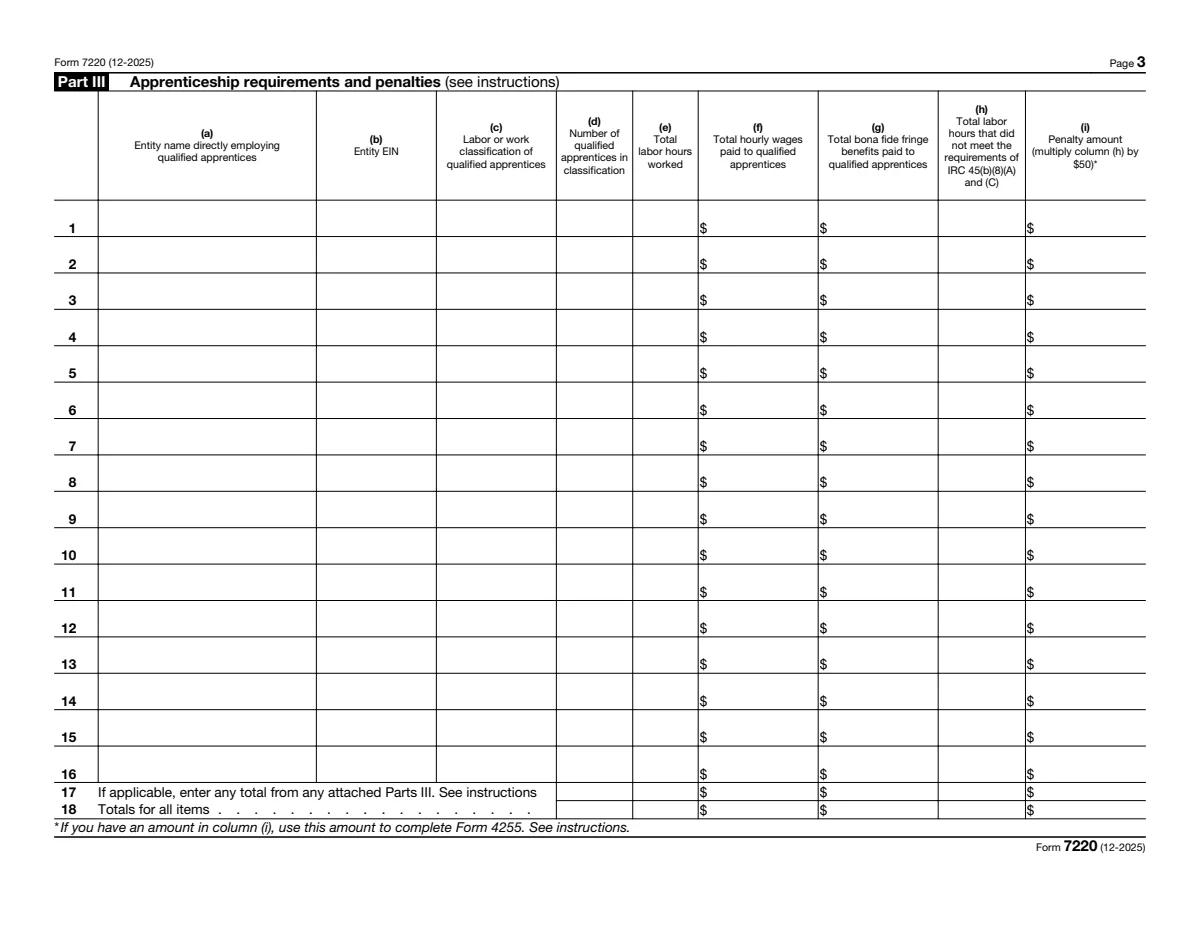
Part III belongs to the placed-in-service year only, because the apprenticeship tests cover work before the facility is placed in service. The three tests (labor hours, daily ratio, participation by any employer with four or more workers) are in the apprenticeship requirement guide. “Labor hours don’t include hours worked by foremen, superintendents, owners, or persons employed in bona fide executive, administrative, or professional capacities”.
| Line | Label | What goes there |
|---|---|---|
| III(a) | Entity name directly employing qualified apprentices | The taxpayer, contractor or subcontractor that directly employs the apprentices. |
| III(b) | Entity EIN | The EIN of that entity. |
| III(c) | Labor or work classification of qualified apprentices | The Davis-Bacon classification, named as in Part II. |
| III(d) | Number of qualified apprentices in classification | Apprentices in a program registered with DOL's Office of Apprenticeship or a recognized state apprenticeship agency. |
| III(e) | Total labor hours worked | Hours worked by those apprentices. Hours over the program's daily ratio count in total labor hours, not as apprentice hours (1.45-8(c)(3))Treas. Reg. 1.45-8Treasury regulations, eCFR. |
| III(f) | Total hourly wages paid to qualified apprentices | Wages paid to those apprentices. |
| III(g) | Total bona fide fringe benefits paid to qualified apprentices | Fringe benefits paid to those apprentices. |
| III(h) | Total labor hours that did not meet IRC 45(b)(8)(A)IRC 45Internal Revenue Code, Cornell LII and (C) | Shortfall hours; blank if both tests were met. Labor hours test: hours required minus apprentice hours within the ratio and good faith hours (1.45-8(f)(2)(i)(A))Treas. Reg. 1.45-8Treasury regulations, eCFR. Participation test: the failing employer's total labor hours divided by its number of laborers and mechanics (1.45-8(f)(2)(i)(B))Treas. Reg. 1.45-8Treasury regulations, eCFR. |
| III(i) | Penalty amount (column (h) x $50) | Column (h) times $50. “Report column (i), line 18, on the corresponding line of Form 4255, Part I, columns (p)(1), (p)(2), and/or (p)(3).” For intentional disregard the regulation sets $500 an hour (1.45-8(f)(2)(ii))Treas. Reg. 1.45-8Treasury regulations, eCFR; the form shows only $50. |
| III-17 | Totals from any attached Parts III | Totals of extra Part III pages, columns (d) to (i). |
| III-18 | Totals for all items | Rows 1 to 16 plus line 17; column (i) goes to Form 4255. |
Part III column (a) asks for the entity employing qualified apprentices, but a participation shortfall belongs to an employer that had none. The instructions do not say which row carries it. Agree the approach with your tax adviser and keep the calculation.
Part IV: corrections and penalties
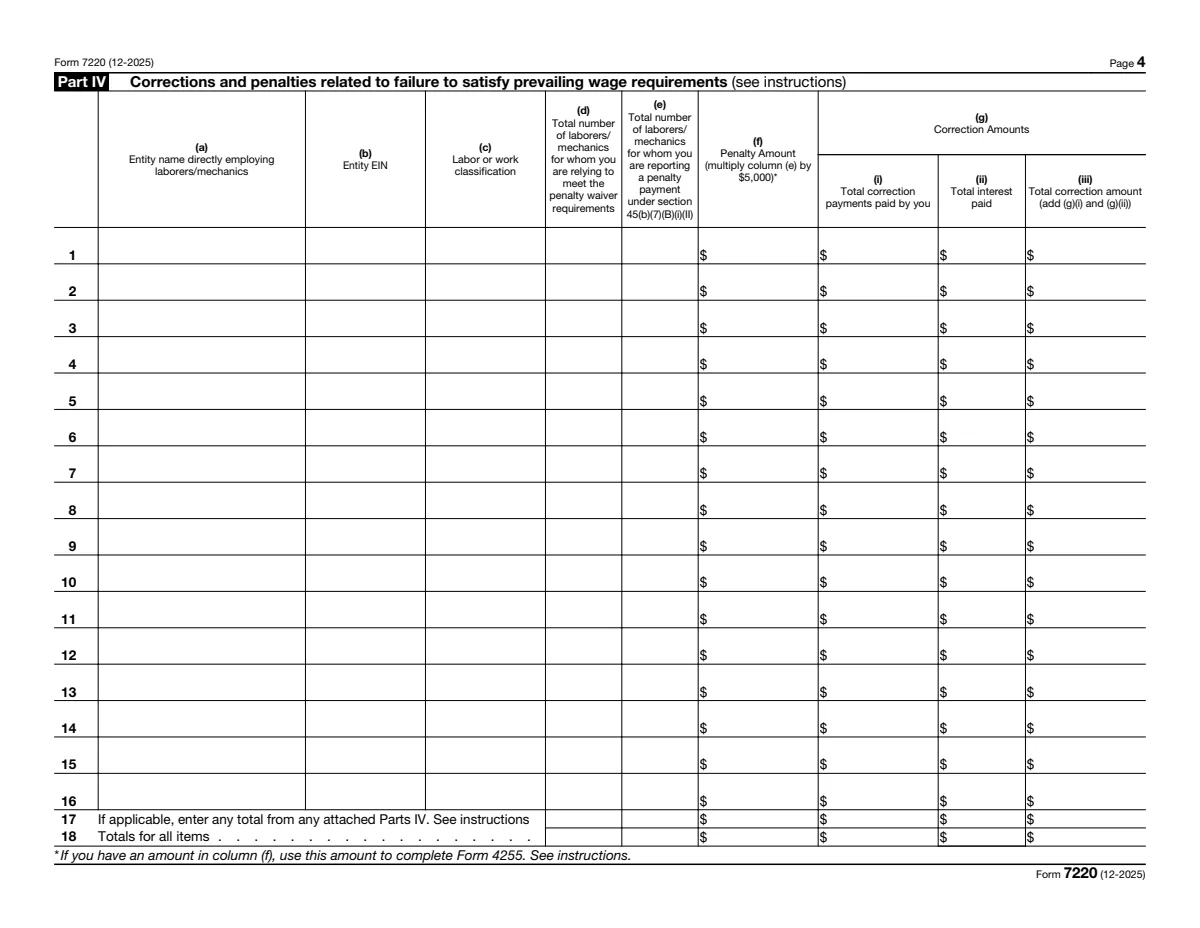
Complete Part IV when line 8 is Yes. Paying the correction and penalty keeps the increased amount: under 1.45-7(c)(1) the taxpayer is then treated as having met the prevailing wage requirements for the year. See fixing PWA failures.
| Line | Label | What goes there |
|---|---|---|
| IV(a) | Entity name directly employing laborers/mechanics | The employer of the underpaid workers. |
| IV(b) | Entity EIN | The EIN of that entity. |
| IV(c) | Labor or work classification | The classification of the underpaid workers. |
| IV(d) | Workers for whom you rely on the penalty waiver | Workers who meet the waiver in Treas. Reg. 1.45-7(c)(6)Treas. Reg. 1.45-7Treasury regulations, eCFR: correction paid “by the last day of the first month that follows the end of the calendar quarter in which the failure occurred”, and underpaid in no more than 10 percent of the year's pay periods or by no more than 5 percent of the wages required. |
| IV(e) | Workers for whom you report a penalty payment | Workers for whom you report the section 45(b)(7)(B)(i)(II) penalty. Leave blank if none. |
| IV(f) | Penalty amount (column (e) x $5,000) | Column (e) times $5,000; the line 18 total goes to Form 4255, Part I, columns (o)(1) to (o)(3). A failure that “is due to intentional disregard if it is knowing or willful” costs $10,000 per worker and triple correction payments (1.45-7(c)(3))Treas. Reg. 1.45-7Treasury regulations, eCFR; the form multiplies by $5,000 only. |
| IV(g)(i) | Total correction payments paid by you | Back wages paid by you, a contractor or a subcontractor: wages required for all hours in the pay period minus wages paid. |
| IV(g)(ii) | Total interest paid | Interest paid on those back wages, at the section 6621 rate with 6 percentage points in place of 3 (1.45-7(c)(1)(i)(B))Treas. Reg. 1.45-7Treasury regulations, eCFR. |
| IV(g)(iii) | Total correction amount | Column (g)(i) plus column (g)(ii). |
| IV-17 | Totals from any attached Parts IV | Totals of extra Part IV pages, columns (d) to (g)(iii). |
| IV-18 | Totals for all items | Rows 1 to 16 plus line 17; column (f) goes to Form 4255. |
Part V: good faith effort
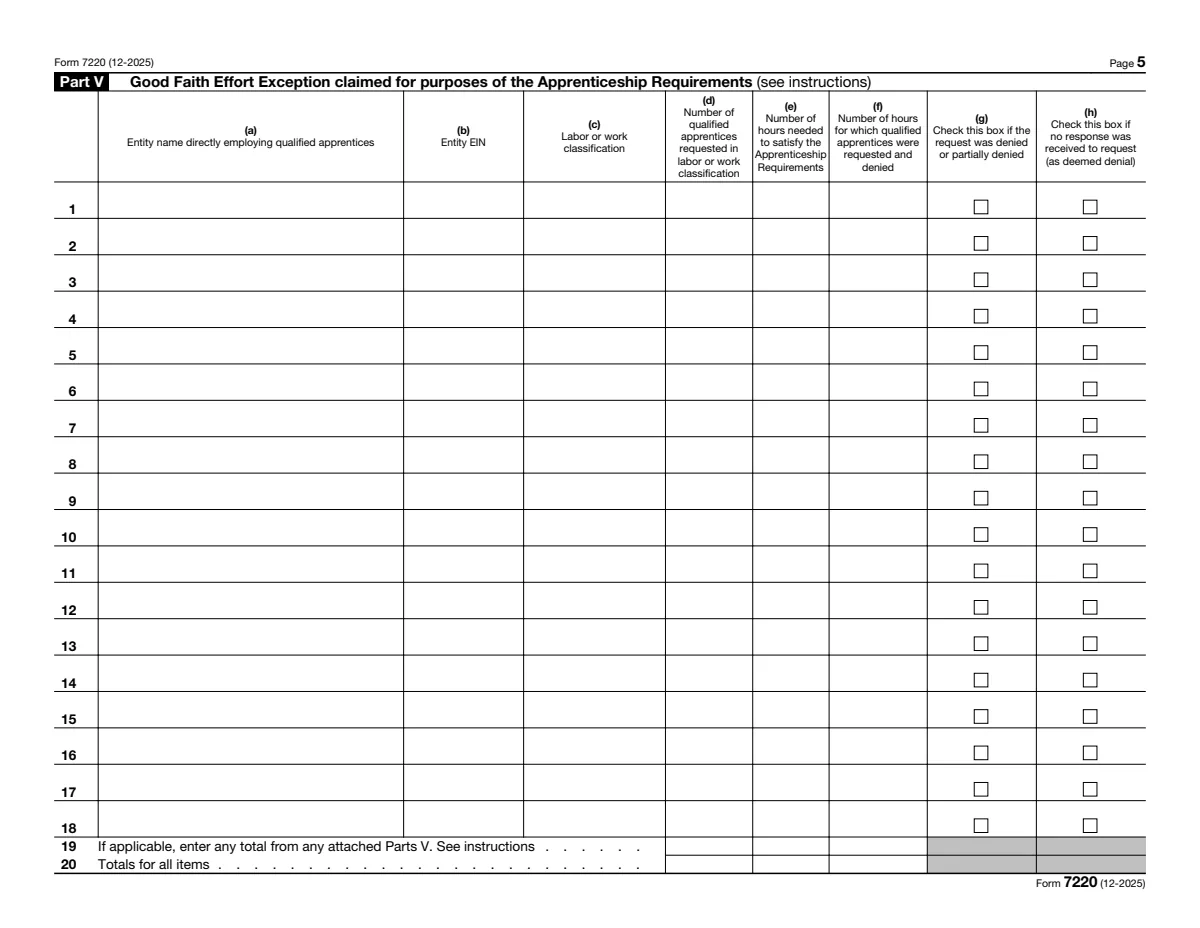
Part V lists each apprentice request you rely on (line 9 Yes). A valid request is written, sent electronically or by registered mail, to a registered program covering the site that trains the occupation. The first request “must be made no later than 45 days before the qualified apprentices are requested to start work”; later requests to the same program, 14 days before. A denied or unanswered request covers the period it names, up to 365 days.
| Line | Label | What goes there |
|---|---|---|
| V(a) | Entity name directly employing qualified apprentices | The entity that requested, and would employ, the apprentices. |
| V(b) | Entity EIN | The EIN of that entity. |
| V(c) | Labor or work classification | The classification requested. |
| V(d) | Qualified apprentices requested | How many apprentices you asked the registered program for. |
| V(e) | Hours needed to satisfy the Apprenticeship Requirements | Hours needed to meet the labor hours requirement of Treas. Reg. 1.45-8(b)Treas. Reg. 1.45-8Treasury regulations, eCFR. |
| V(f) | Hours requested and denied | Apprentice hours requested and denied. Denied hours that qualify count as apprentice hours (1.45-8(f)(1)(i)(B))Treas. Reg. 1.45-8Treasury regulations, eCFR. |
| V(g) | Denied or partially denied | Check for a full or partial denial; leave it unchecked if the program never responded (that is column (h)). On a partial denial, accept the apprentices offered. |
| V(h) | No response (deemed denial) | Check if the program did not respond. The instructions say 5 days; the regulation says five business days after the program received the request (1.45-8(f)(1)(i)(C))Treas. Reg. 1.45-8Treasury regulations, eCFR. |
| V-19 | Totals from any attached Parts V | Totals of extra Part V pages, columns (d) to (f). |
| V-20 | Totals for all items | Rows 1 to 18 plus line 19, columns (d) to (f). |
Rules that matter
Line 6 boxes and how long the form comes back
Form 3468 splits three ways: its instructions require Form 7220 “If you’re claiming a credit under section 48C in Part III; under section 48E in Part V; or under section 48 in Part VI”. The periods below are from the Form 7220 instructions; for 48 and 48E a failed alteration or repair within 5 years can trigger recapture. For which credits are still open after the 2025 law, see credits in 2026.
| Line 6 box | Credit | Prevailing wage period | Part III |
|---|---|---|---|
| Form 3468, Part III | 48C advanced energy project | Construction only | Yes |
| Form 3468, Part V | 48E clean electricity investment | Construction; alteration or repair for 5 years | Yes |
| Form 3468, Part VI | 48 energy credit | Construction; alteration or repair for 5 years | Yes |
| Form 7205 | 179D commercial buildings deduction | Construction (installation) only | Yes |
| Form 7210 | 45V clean hydrogen | Construction; alteration or repair for 10 years | Yes |
| Form 7211 | 45Y clean electricity production | Construction; alteration or repair for 10 years | Yes |
| Form 7213, Part II | 45U nuclear power production | Alteration or repair only | No |
| Form 7218 | 45Z clean fuel production | Placed in service before 2025: alteration or repair after 2024 only | Yes |
| Form 8835 | 45 renewable electricity production | Construction; alteration or repair for 10 years | Yes |
| Form 8908 | 45L energy efficient home | Construction only | No |
| Schedule A (Form 8911), Part II | 30C refueling property | Construction only | Yes |
| Form 8933 | 45Q carbon oxide sequestration | Construction; alteration or repair for 12 years | Yes |
Cure deadlines and special cases
- After an IRS finding. The cure works only if payments are made within 180 days of a final determination, which “occurs on the date the IRS sends to the taxpayer a notice stating that the taxpayer has failed to satisfy the Prevailing Wage Requirements” (1.45-7(c)(4))Treas. Reg. 1.45-7Treasury regulations, eCFR.
- Deficiency procedures. The $5,000 penalty can be assessed without them (1.45-7(c)(2))Treas. Reg. 1.45-7Treasury regulations, eCFR; the $50 penalty is subject to them (1.45-8(f)(2)(iii))Treas. Reg. 1.45-8Treasury regulations, eCFR.
- Workers you cannot find. Paying under state unclaimed property law, with the required withholding and reporting, counts (1.45-7(c)(1)(v))Treas. Reg. 1.45-7Treasury regulations, eCFR.
- Transferred credits. The seller keeps the correction and penalty duties (1.45-7(c)(1)(iv))Treas. Reg. 1.45-7Treasury regulations, eCFR. If no cure is made, the buyer owes the excessive credit transfer plus 20 percent unless it shows reasonable cause (IRC 6418(g)(2))IRC 6418Internal Revenue Code, Cornell LII; see elected or transferred credits.
The records behind each column
Under Treas. Reg. 1.45-12(b)Treas. Reg. 1.45-12Treasury regulations, eCFR, “At a minimum, those records include payroll records for each laborer and mechanic (including each qualified apprentice)”. The rule also lists Forms WH-347 (see the WH-347 guide), wage determinations and contracts, daily ratio records, good faith requests and denials, and the calculation of every correction and penalty. The PWA records guide covers each item.
Worked examples
Made-up numbers showing the arithmetic the regulations prescribe. Part III: construction began in 2024, so apprentices must perform 15% of labor hours. One request was denied, and one subcontractor never had an apprentice.
| Step | Hours or amount | How |
|---|---|---|
| Total labor hours (apprentices included, foremen and owners excluded) | 80,000 | From payroll |
| Apprentice hours required (construction began 2024) | 12,000 | 80,000 × 15% |
| Apprentice hours within the daily ratio | 10,000 | 10,400 worked, 400 over the ratio |
| Good faith hours (Part V column (f)) | 1,000 | A denied request |
| Labor hours shortfall | 1,000 | 12,000 − (10,000 + 1,000) |
| Participation shortfall: a sub with 5 workers, 2,000 hours, no apprentice | 400 | 2,000 ÷ 5 |
| Column (i), line 18 | $70,000 | 1,400 hours × $50, to Form 4255 |
Part IV: a payroll review finds two underpaid workers. For a second-quarter failure the waiver deadline is July 31.
| Worker | Facts | Waiver test | Result |
|---|---|---|---|
| Worker A | Underpaid $150 in 2 of 30 weekly pay periods in May; back pay and interest paid July 20 | 6.7% of pay periods, paid by July 31 | Waiver: column (d), no penalty |
| Worker B | Underpaid 8% all year ($2,400 of $30,000); paid the next January | Over 10%, over 5%, and late | No waiver: column (e), $5,000 |
The Part IV row shows (d) 1, (e) 1, (f) $5,000, and $2,700 of back wages in (g)(i) plus the interest paid in (g)(ii). Worker A still gets back pay and interest; the waiver removes only the penalty. Paying before an IRS exam notice also raises a rebuttable presumption of no intentional disregard (1.45-7(c)(3)(v))Treas. Reg. 1.45-7Treasury regulations, eCFR.
Common mistakes
- Filing under an exception. The beginning of construction and one megawatt exceptions need no Form 7220.
- One form for several facilities. Each facility gets its own.
- Skipping later years. With no alteration or repair, check line 10 No and attach the signed statement.
- Leaving apprentices out of Part II. Columns (e) to (g) include them.
- Counting hours over the ratio as apprentice hours. They count in total hours only.
- Forgetting Form 4255. The line 18 penalty totals of Parts III and IV go there.
Questions filers ask
Does a subcontractor file Form 7220?
No. The taxpayer claiming the increased amount files it. Each contractor and subcontractor appears in Parts II to V by name, EIN and classification, so the taxpayer needs its payroll data.
Do I need Form 7220 if construction began before January 29, 2023?
No. A facility using the beginning of construction exception, or the one megawatt exception, does not file it. The instructions point to T.D. 9998, T.D. 10015 and T.D. 10024.
Where are the penalties paid?
Form 7220 computes them. Line 18 of Part III column (i) goes to Form 4255, Part I, columns (p)(1) to (p)(3); line 18 of Part IV column (f) goes to columns (o)(1) to (o)(3).
What if I sold the credit under section 6418?
The seller keeps the correction and penalty duties (Treas. Reg. 1.45-7(c)(1)(iv) and 1.45-8(f)(2)(iv))Treas. Reg. 1.45-7Treasury regulations, eCFRTreas. Reg. 1.45-8Treasury regulations, eCFR and the records duty (1.45-12(a))Treas. Reg. 1.45-12Treasury regulations, eCFR. Line 1 asks for the registration number when you make a transfer election. If the seller does not cure a failure, the buyer bears the excessive credit transfer plus 20 percent under IRC 6418(g)(2)IRC 6418Internal Revenue Code, Cornell LII, so expect buyers to ask for this form and its records.
Is Form 7220 needed for 45L or 45U?
Yes, for the increased amount, but only the prevailing wage part applies: skip Part III and check Not applicable on line 9.