- Form
- WH-347, Rev. January 2025
- OMB No.
- 1235-0008, expires 01/31/2028
- Required?
- Form optional; weekly certified payroll required
- Pages
- 2: payroll and Statement of Compliance
- Goes to
- The agency, or the applicant or owner; subs through the prime
At a glance
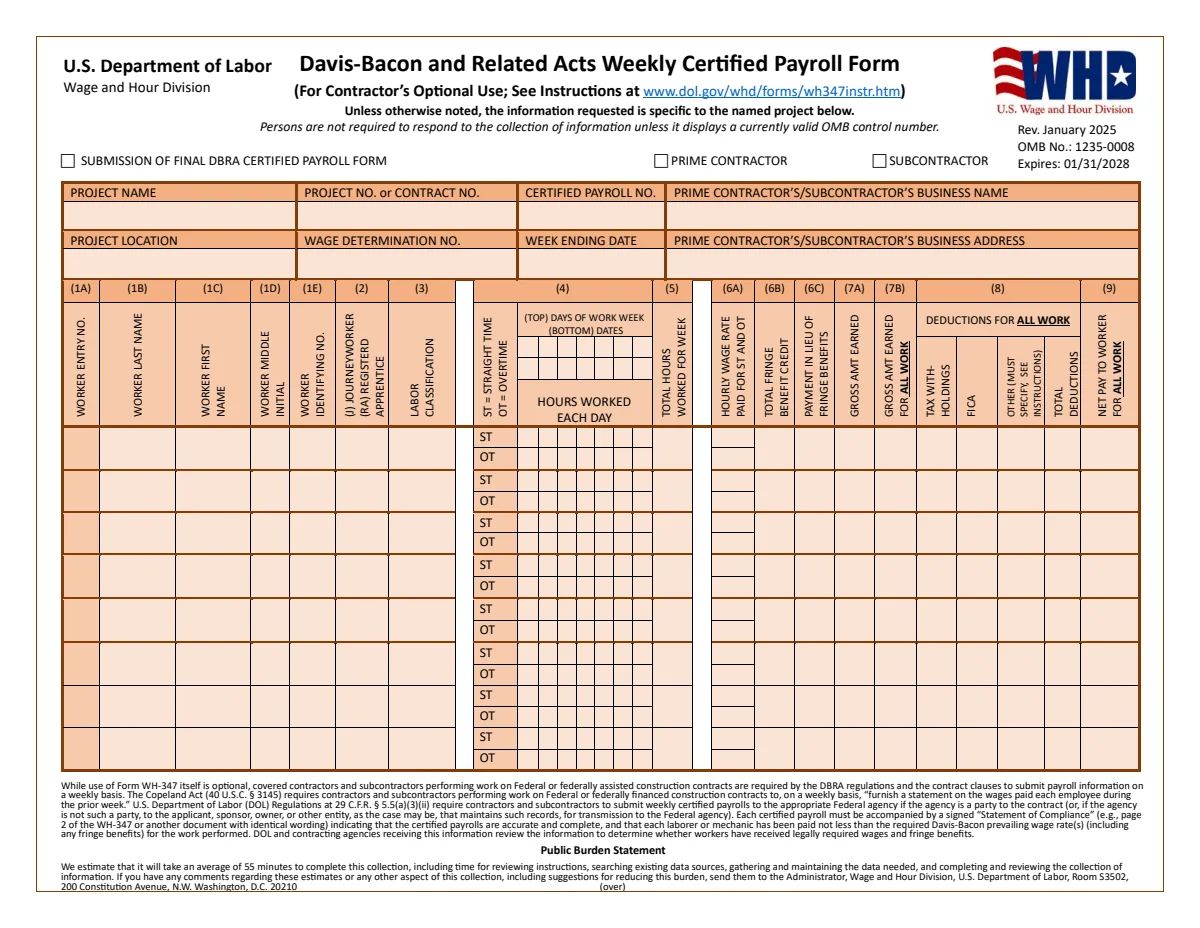
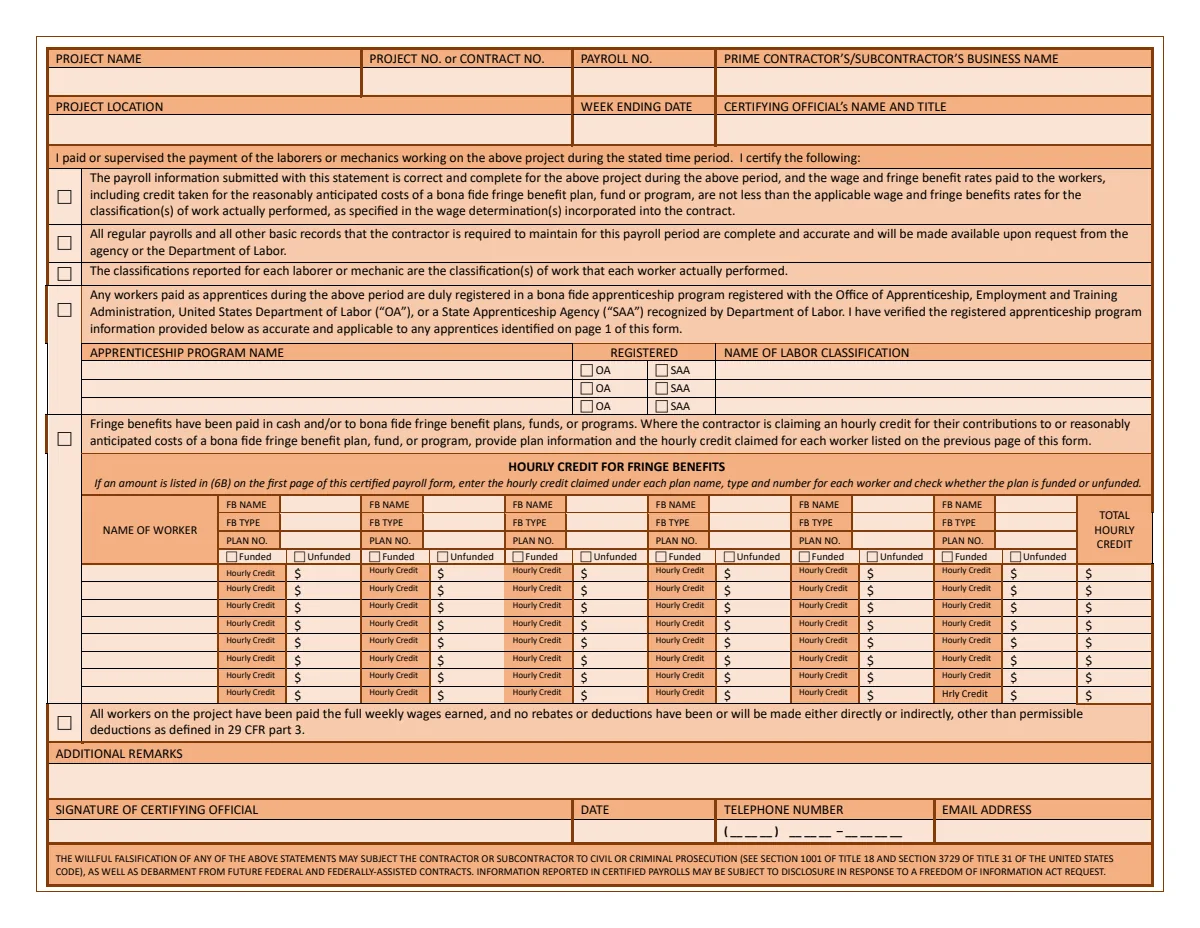
Form WH-347 is DOL's weekly certified payroll form for construction work under the Davis-Bacon and Related Acts. The current version is marked Rev. January 2025, OMB No. 1235-0008, expires 01/31/2028. It has two pages: page 1 is the payroll itself, one or two rows per worker, and page 2 is the Statement of Compliance that makes it a certified payroll.
- The form is optional; the weekly payroll is not. DOL's instructions say “While use of Form WH-347 itself is optional”, covered contractors and subcontractors must still submit payroll information every week. 29 CFR 5.5(a)(3)29 CFR 5.5Code of Federal Regulations, eCFR(ii)(B) says the weekly information “may be submitted using Optional Form WH-347 or in any other format desired”, as long as it carries everything the rule requires.
- Who files. The prime contractor and every subcontractor with laborers or mechanics on the job, for each week in which covered work is performed. See who files certified payroll.
- Who signs. The contractor or subcontractor, or the agent who paid or supervised the payment of the workers that week. The signer certifies under 18 U.S.C. 100118 U.S.C. 1001United States Code, Cornell LII.
- Where it goes. To the federal agency if it is a party to the contract. If not, to the applicant, sponsor, owner or other entity that keeps the records, which sends them on to the agency. The prime contractor is responsible for submitting every subcontractor's payrolls.
- Keep it. Certified payrolls are kept during the work and for 3 years after all work on the prime contract is completed (29 CFR 5.5(a)(3)(ii)(G))29 CFR 5.5Code of Federal Regulations, eCFR.
DOL posts the PDF and an online fillable version of the form on its WH-347 page, with the instructions this guide follows. An agency or prime may also require an electronic payroll system, provided it accepts legally valid electronic signatures, keeps payrolls available for at least 3 years, and allows another method for a contractor that cannot use it (29 CFR 5.5(a)(3)(ii)(A))29 CFR 5.5Code of Federal Regulations, eCFR. DOL estimates the form takes an average of 55 minutes to complete.
Tap a box once for its note, again to jump to the line. Zoom in to read the small print.
Page 1, line by line
Every note below comes from DOL's instructions for the form, with the regulation added where it settles the point. The check boxes and header fields come first.
| Line | Label | What goes there |
|---|---|---|
| Final | Submission of final DBRA certified payroll form | Mark the box only when “this submission is for the final week of work on the project for the contractor or subcontractor”. Each contractor marks its own final week: a subcontractor that finishes early marks its last payroll even though the project goes on. |
| Prime | Prime contractor | Mark it if you hold the prime contract. The instructions ask you to mark whichever box shows whether you are the prime or a subcontractor on the project. |
| Sub | Subcontractor | Mark it if you are a subcontractor. Under 29 CFR 5.5(a)(3)29 CFR 5.5Code of Federal Regulations, eCFR(ii)(A), “The prime contractor is responsible for the submission of all certified payrolls by all subcontractors.” |
| Project | Project name | The name of the project you are reporting on. Use the same name every week so the agency can match your payrolls. |
| Proj-No | Project no. or contract no. | The project number or the prime contract number assigned by the contracting agency, if available. The instructions ask for the agency's number, so a subcontractor enters the project or prime contract number, not an internal job number. |
| Payroll-No | Certified payroll no. | Start at 1 with your first weekly payroll on the project and give each later weekly payroll the next number. |
| Name | Prime contractor's/subcontractor's business name | Your business's legal name. |
| Location | Project location | The complete project address. If there is no specific address, describe the location, including at least the county or counties and the state. |
| WD-No | Wage determination no. | Each wage determination number and revision number included in the contract that applied to the work your workers did this pay period. If several determinations apply to the project, list every one that covered work done this week. See wage determinations. |
| Week | Week ending date | The last day of the workweek for this pay period. The dates across the top of column 4 run up to this date. |
| Address | Prime contractor's/subcontractor's business address | The company's full business address. |
Then one set of rows per worker. Each worker gets an ST row and an OT row; a worker who worked in two classifications in the week gets a second pair with the same entry number.
| Line | Label | What goes there |
|---|---|---|
| 1A | Worker entry no. | Number each worker starting at 1. Rows continue onto the next sheet (row 1 of the second sheet may be entry 9). A worker who worked in two classifications gets a separate row for each, “the same worker entry number should be used on each row associated with the worker”. |
| 1B | Worker last name | Self-explanatory, says DOL. |
| 1C | Worker first name | Self-explanatory. |
| 1D | Worker middle initial | Self-explanatory. |
| 1E | Worker identifying no. | An individual number for each worker, such as the last four digits of the Social Security number or another number unique to that worker. The instructions are blunt: “workers' full Social Security numbers must not be included”. The full number stays in your own payroll records under 29 CFR 5.5(a)(3)(i)(B)29 CFR 5.5Code of Federal Regulations, eCFR. |
| 2 | (J) Journeyworker / (RA) Registered apprentice | J for a journeyworker, RA for an apprentice registered in a program approved by DOL's Office of Apprenticeship or a State Apprenticeship Agency. For an apprentice, add the level of progression in the program. |
| 3 | Labor classification | The classification for the work actually performed, taken from the wage determination in the contract. If the work has no classification on the wage determination, contact the contracting officer or agency representative right away (the conformance process). If you did not keep an accurate breakdown of hours by classification, “the worker must be paid for all hours worked using the highest applicable prevailing wage rate (basic hourly rate and fringe benefits)”. |
| 4 | Hours worked each day | Above row 1, enter the first letter of each day of your workweek (top) and the date (bottom); a Tuesday to Monday workweek runs T, W, T, F, S, S, M. In each worker's rows, enter hours on this project as straight time (ST) and overtime (OT). On contracts covered by the Contract Work Hours and Safety Standards Act, hours over 40 in the week are OT, counting hours worked on and off the site of the work. See Davis-Bacon overtime. |
| 5 | Total hours worked for week | The total of the hours in column 4. |
| 6A | Hourly wage rate paid for ST and OT | The actual hourly rate paid for work in the column 3 classification: straight time on the top row, overtime on the bottom row. If you paid more than the wage determination rate, show what you actually paid. Do not put cash in lieu here: “do not include cash payments in lieu of fringe benefits in this column”. |
| 6B | Total fringe benefit credit | The total of your plan contributions or reasonably anticipated costs for which you take credit against the fringe benefit rate. It equals the worker's total hours (column 5) times the worker's Total Hourly Credit from the table on page 2. See Davis-Bacon fringe benefits. |
| 6C | Payment in lieu of fringe benefits | The total cash paid to the worker in place of fringe benefits for the week: total hours times the hourly cash in lieu rate. |
| 7A | Gross amount earned | The worker's gross amount earned for the workweek for hours on this federal or federally assisted project. |
| 7B | Gross amount earned for all work | If part of the week's pay came from other projects or other work, including work not covered by Davis-Bacon, the gross for all work in the week. If the worker worked only on this project, 7B equals 7A. |
| 8 | Deductions for all work | All deductions taken from the column 7B gross. “If a worker worked on other jobs in addition to this project, do not pro-rate the deductions”; show the actual deductions from the whole week's pay. Every deduction must comply with the Copeland Act regulations in 29 CFR part 329 CFR part 3Code of Federal Regulations, eCFR, and any deduction not listed in 29 CFR 3.529 CFR 3.5Code of Federal Regulations, eCFR needs DOL's prior approval. |
| 8-Tax | Tax withholdings | Income tax withheld. Deductions required by federal, state or local law need no DOL approval under 29 CFR 3.5(a)29 CFR 3.5Code of Federal Regulations, eCFR. |
| 8-FICA | FICA | Social Security and Medicare tax withheld. |
| 8-Other | Other (must specify, see instructions) | Any other deduction. If the amount is one deduction, describe it under Additional Remarks on page 2. If it combines two or more, attach an addendum that lists each deduction with a description and amount. 29 CFR 3.529 CFR 3.5Code of Federal Regulations, eCFR lists the deductions allowed without DOL approval, such as credit union payments and union dues under a collective bargaining agreement, each with conditions. |
| 8-Total | Total deductions | The total of all deductions actually made: tax withholdings plus FICA plus Other. |
| 9 | Net pay to worker for all work | The actual dollar amount paid to the worker for all hours worked across all projects that week, including projects not covered by Davis-Bacon. It should equal 7B minus the column 8 total. |
Page 2 and the Statement of Compliance
Page 2 is what makes the payroll certified. 29 CFR 5.5(a)(3)29 CFR 5.5Code of Federal Regulations, eCFR(ii)(D) says a properly executed statement on the reverse side of the WH-347 satisfies the Statement of Compliance requirement; if you use your own payroll format, attach a statement with identical wording. The instructions set the rule for the six boxes: “Boxes 1, 2, 3 and 6 (i.e., the first three boxes and the last box) always must be checked”. Box 4 is checked only when someone was paid as an apprentice that week, and box 5 when you meet any part of the fringe benefit rate. The Statement of Compliance guide covers each box and the signing rules in more depth.
| Line | Label | What goes there |
|---|---|---|
| P2-Project | Project name | Repeat the project name from page 1. |
| P2-Proj-No | Project no. or contract no. | The project or prime contract number assigned by the contracting agency, if available. |
| P2-Payroll-No | Payroll no. | The same weekly payroll number as page 1. |
| P2-Name | Business name | Your business's legal name. |
| P2-Location | Project location | Same rule as page 1: full address, or the county or counties and state. |
| P2-Week | Week ending date | The workweek ending date for this pay period. |
| Official | Certifying official's name and title | Print the name and title of the contractor or subcontractor, or the agent, who paid or supervised the payment of the workers during the week the form covers. That is the person who signs below, and the instructions say the signer should know the facts certified. |
| SOC-1 | Box 1 | Payroll information correct and complete; wage and fringe rates paid (including any credit for a bona fide plan) not less than the wage determination rates for the classifications actually worked. Always checked. |
| SOC-2 | Box 2 | All regular payrolls and basic records are complete and accurate and will be made available to the agency or DOL on request. Always checked. |
| SOC-3 | Box 3 | The classification reported for each worker is the work that worker actually performed. Always checked. |
| SOC-4 | Box 4 | Anyone paid as an apprentice is registered in a program registered with DOL's Office of Apprenticeship (OA) or a recognized State Apprenticeship Agency (SAA), and you verified the program information below. Check it only if someone was paid as an apprentice this week. |
| Apprentice | Apprenticeship program name, registered (OA or SAA), labor classification | List each program with registered apprentices on the project this payroll period, mark OA or SAA, and enter the labor classification. More than three programs: attach an addendum. If box 4 does not apply, leave it unchecked and enter Not Applicable or N/A under Apprenticeship Program Name. |
| SOC-5 | Box 5 | Fringe benefits have been paid in cash, to bona fide plans, funds or programs, or both. If you pay the full fringe in cash, the instructions say “check the box but do not complete the subsection”; the cash shows in column 6C. |
| Fringe | Hourly credit for fringe benefits | Complete it when you claim a credit for plan contributions or anticipated costs (any amount in 6B). First column: each worker's entry number from 1A and name, in page 1 order. Plan columns: plan name (row 1), plan type (row 2), plan number (row 3), funded or unfunded (row 4), then the hourly credit for each worker under each plan. Six plan columns; more plans go on an addendum. For an unfunded plan, “the contractor or subcontractor must have prior approval from the Department of Labor prior to claiming such credit as required in 29 CFR 5.2829 CFR 5.28Code of Federal Regulations, eCFR”. |
| Total-Credit | Total hourly credit | The total hourly fringe credit for each worker, the sum of that worker's plan credits. This is the hourly figure that column 6B multiplies by total hours. |
| SOC-6 | Box 6 | All workers were paid the full weekly wages earned, with no rebates or deductions, directly or indirectly, other than those permitted by 29 CFR part 329 CFR part 3Code of Federal Regulations, eCFR. Always checked. |
| Remarks | Additional remarks | Optional space for deductions, hourly fringe costs or other explanations. If you continue on separate pages, put the contractor and project information from the form on them too. |
| Signature | Signature of certifying official | Signed by the contractor or subcontractor, or the agent who paid or supervised payment of the workers that week. Legally valid electronic signatures are accepted. “Photocopies or scanned copies of signatures do not satisfy this requirement.” The statement does not need to be notarized. |
| Date | Date | The date the statement was signed. |
| Phone-Email | Telephone number, email address | The phone number and email address of the person who signed. |
The fringe table and column 6B must agree. For each worker, 6B on page 1 equals total hours in column 5 times the Total Hourly Credit on page 2. If you pay part of the fringe in cash, that part goes in 6C, not in the table.
Worked example: one worker's row
These numbers are an example, not a rate from any wage determination. They follow the third CWHSSA example in DOL's Prevailing Wage Resource Book: an electrician whose wage determination rate is $35.00 an hour plus $15.00 in fringe benefits, who works 44 hours on a covered contract. The contractor pays $35.00 an hour in cash wages, $5.00 an hour cash in lieu of fringes, and $10.00 an hour into two fringe plans (in our example, a health plan at $6.00 and a pension plan at $4.00).
Page 2 first. In the Hourly Credit for Fringe Benefits table, row 1 gets entry number 1 and the worker's name. Plan column 1: the health plan's name, type and plan number, Funded, hourly credit $6.00. Plan column 2: the pension plan, Funded, $4.00. Total hourly credit: $6.00 + $4.00 = $10.00. Box 5 is checked.
Then page 1. The worker works 8 hours Monday through Friday and 4 hours Saturday. Hours over 40 in the week are overtime under the Contract Work Hours and Safety Standards Act, and DOL's resource book says fringe amounts, including plan contributions and cash in lieu, “are excluded in computing overtime obligations under CWHSSA”. So the overtime rate is one and one-half times the $35.00 basic rate, not times $50.00.
| Column | Entry | Arithmetic |
|---|---|---|
| 1A to 1E | Entry 1, last name, first name, initial, last four of SSN | Identity only |
| 2 | J | Journeyworker |
| 3 | Electrician | From the wage determination |
| 4 | M to F: 8 ST each day; S: 4 OT | Hours over 40 in the week are OT on a CWHSSA contract |
| 5 | 44 | 40 + 4 |
| 6A | $35.00 top row; $52.50 bottom row | OT rate: $35.00 × 1.5 = $52.50 |
| 6B | $440.00 | 44 hours × $10.00 total hourly credit (page 2) |
| 6C | $220.00 | 44 hours × $5.00 cash in lieu |
| 7A | $1,830.00 | $1,400.00 ST (40 × $35.00) + $210.00 OT (4 × $52.50) + $220.00 cash in lieu (see the note below) |
| 7B | $1,830.00 | No other work this week, so the same as 7A |
| 8 | Actual tax, FICA and other amounts | Taken from the 7B gross |
| 9 | 7B minus the 8 total | The amount actually paid |
Check against the wage determination. Per hour, the worker received $35.00 cash + $5.00 cash in lieu + $10.00 plan credit = $50.00, equal to the $35.00 + $15.00 required. For the week: $1,400.00 + $210.00 + $220.00 + $440.00 = $2,270.00, the same total DOL's resource book reaches ($1,540.00 straight wages for 44 hours, $220.00 cash in lieu, $440.00 fringes and $70.00 overtime premium).
Column 7A: the instructions define it only as the gross amount earned on the project. They do not say in so many words whether the 6C cash in lieu belongs in it. The example includes the $220.00 because the worker received it in cash, and leaves out the $440.00 that went to the plans. If your contracting agency wants it shown another way, follow the agency.
Common mistakes the instructions warn about
- Full Social Security numbers in 1E. Only an identifying number, such as the last four digits.
- Cash in lieu in column 6A. 6A is the hourly wage rate only; cash paid in place of fringes goes in 6C.
- One row for two classifications. Without a row and accurate hours for each, all hours are owed at the highest applicable rate.
- A classification that is not on the wage determination. Contact the contracting officer or agency representative right away.
- Prorating deductions. Show the actual deductions from the whole week's pay.
- An unexplained Other deduction. Describe a single one in Additional Remarks; itemize two or more on an addendum. Deductions not listed in 29 CFR 3.529 CFR 3.5Code of Federal Regulations, eCFR need DOL's prior approval (see the list at 29 CFR 3.5).
- Credit for an unfunded plan without approval. It needs DOL approval under 29 CFR 5.2829 CFR 5.28Code of Federal Regulations, eCFR first.
- A fringe table that does not match 6B. 6B must equal total hours times the Total Hourly Credit on page 2.
- Unchecked boxes 1, 2, 3 or 6. They are never optional. Box 4 unchecked needs N/A under the program name.
- A scanned or photocopied signature. Sign by hand or with a legally valid electronic signature.
The certification has teeth. The form warns that willful falsification may lead to civil or criminal prosecution under 18 U.S.C. 100118 U.S.C. 1001United States Code, Cornell LII and 31 U.S.C. 372931 U.S.C. 3729United States Code, Cornell LII and to debarment, and 29 CFR 5.5(a)(3)29 CFR 5.5Code of Federal Regulations, eCFR(ii)(F) says the same of the certifications. A payroll with gaps can also hold up payment: 29 CFR 5.5(a)(2)29 CFR 5.5Code of Federal Regulations, eCFR lets the agency suspend payments when a contractor fails to submit required records. The full clause is at 29 CFR 5.5 on eCFR.
Questions filers ask
Do I have to use Form WH-347?
No. The form is optional. You may use any format, including a payroll system's report, as long as it shows everything 29 CFR 5.5(a)(3)29 CFR 5.5Code of Federal Regulations, eCFR(ii)(B) requires and comes with a signed Statement of Compliance with the same wording as page 2 of the WH-347.
Is there an online fillable WH-347?
Yes. DOL's WH-347 page links to the PDF, an annotated guide and an online fillable version of the form. Your contracting agency or prime may still require its own electronic system.
Do I file a WH-347 for a week with no work on the project?
The rule requires a certified payroll for each week in which any covered work is performed. It says nothing about weeks with no covered work, so ask your contracting agency or prime what it wants for those weeks.
Who can sign the WH-347?
The contractor or subcontractor, or its agent who paid or supervised the payment of the workers that week. The signer should know the facts, since the statement is made under 18 U.S.C. 100118 U.S.C. 1001United States Code, Cornell LII. It does not need a notary.
How do I show a worker who also worked on a private job that week?
Column 4 and 7A show only this project. Column 7B shows the gross for all work, covered or not, and columns 8 and 9 show the actual deductions and net pay for the whole week. Under CWHSSA, overtime counts hours over 40 on covered contracts, on and off the site of the work.
What goes on the WH-347 for an apprentice?
RA in column 2 with the level of progression, the apprentice rate actually paid in 6A, box 4 checked on page 2, and the program's name, OA or SAA registration and classification in the apprenticeship entries.